Turning maritime regulation into commercial and financial decisions.
Carbon and resilience exposure, priced before the fixture is signed. RCA builds decision tools for charterers, brokers and owners of every size, and for the banks that finance them. Each figure is traced to the regulation that creates it, with its assumptions on the page, so the desk sees what the estimate rests on and what moves it.
Your data. Your model. Your decision.
Each tool is a single file on the desk's own computer. No login, no server, no internet connection needed.
Fixtures, fleet data and loan books stay on your machines. The tools make no network request at all.
The methodology is transferred to you, so the tool keeps working without a subscription or a dependency on us.
Checked to 8 Nov 2026. Each build carries the date to which EU ETS, FuelEU Maritime, CII and the distance table were reviewed. When a rule changes, clients receive an updated build with the change named in its changelog.
What does this fixture really cost once carbon is in?
Voyage result, break-even freight and the allocation clause, on one desk.
MCCS Charterer & Broker → OwnersWhich vessels carry the liability, and when do they stop paying?
Fleet compliance, FuelEU trajectory, hold-or-sell timing and disclosure.
MCCS Owner → BanksHow much of the loan book is exposed to maritime carbon rules?
Credit stress, Poseidon alignment and climate-adjusted collateral.
MCCS-BV →The same Capesize, two discharge ports
Iron ore from Ponta da Madeira in Brazil, once to Rotterdam and once to Qingdao. More than twice the distance to China, and no European carbon cost, because neither end is in the EU.
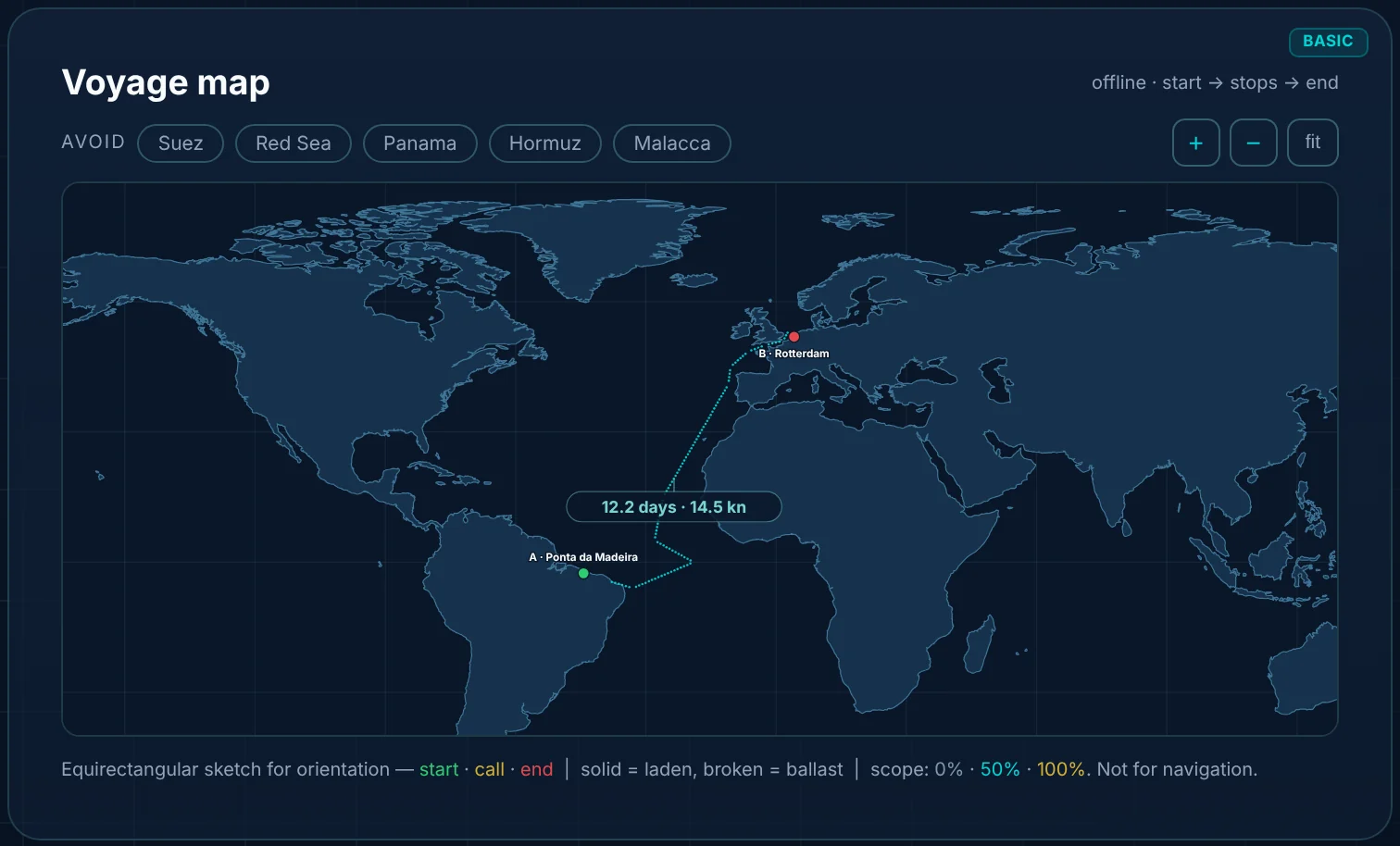
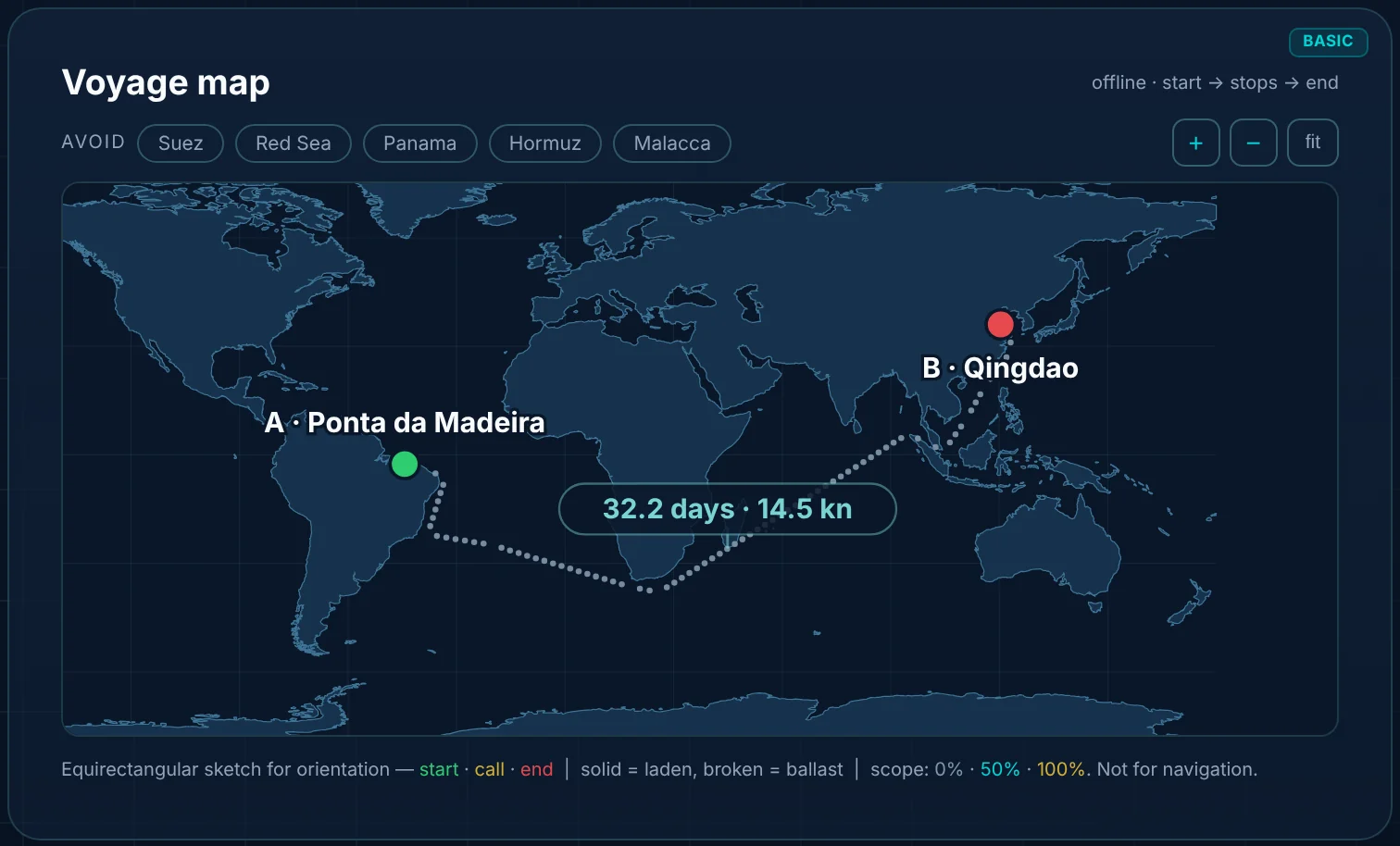
Screens from MCCS Broker v4.24.6 · Capesize class archetype (~180k DWT, HFO, 52 t/day at 14.5 kn) · 170,000 t cargo · laden leg only, no port or berth time · 50% of the Rotterdam voyage in scope, 1,004 t CO₂e (CO₂ with CH₄ and N₂O, the basis the ETS applies from 2026) · EUA €85, FuelEU target year 2026 at €2,400 per tonne VLSFO-equivalent · distances from the RCA port table, read against a voyage planner on 7 Nov 2026 · illustrative.
What moves it: the figure follows the fuel burned, so 10% more consumption adds about €10,300; every €1 on the EUA adds about €1,000. The class range the desk shows for this voyage is €87,600–€118,500. A named vessel's own consumption replaces the archetype.
Maritime Compliance Study
NIS2, CER, EU ETS, FuelEU Maritime and SEC/SOX read together for a shipping group listed on NYSE or Nasdaq.
Contents → MCCSMaritime Carbon Compliance Suite
A fixture decision desk that prices EU ETS, FuelEU Maritime and IMO exposure for charterers, brokers and owners.
Modules → MCRCMaritime Compliance & Resilience Console
Controls, incidents, insurance notification clocks and a tamper-evident log, mapped to class and vetting schemes.
Overview → MCCS-BVBanking edition
Maritime carbon exposure across a shipping loan book, with base and stressed credit views.
Overview → CSDRCarbon Scope & Distance Reference
In preparationEU ETS and FuelEU scope for every tabulated port pair, with distances and voyage templates.
Overview →From a single broking desk to a listed group
Each tool comes in editions, so a desk uses only what fits its side of the contract and its size.
Where each desk starts
The tools are built in editions, so a broker, a charterer or a private owner with a handful of ships uses only what fits the desk, and a listed group adds the fleet, disclosure and cyber layers.
| Who | What they use it for | Where to start |
|---|---|---|
| Shipbrokers | Price carbon into the offer, show who pays, draft the allocation clause | MCCS Broker |
| Charterers & commodity traders | Compare candidate vessels on voyage result, carbon per tonne of cargo, CIF or FOB | MCCS Charterer |
| Private & smaller owners | Fixture desk, FuelEU per vessel, Poseidon statement for the lender, hold or sell timing | MCCS Owner SME |
| Ship managers & operators | Cyber controls, incident clocks and evidence for vetting, class and insurers | MCRC |
| Listed shipping groups | Full fleet compliance and disclosure, resilience and cyber governance, the five regulatory layers together | MCCS Owner · MCRC · Study |
| Banks & lessors | Carbon exposure across the financed fleet, credit stress, collateral, alignment | MCCS-BV |
| Every desk | EU ETS and FuelEU scope and the sailing distance for each port pair, ready to quote | Scope & Distance Reference |
Groups listed in Athens and New York
Listed groups and the banks that lend to them answer to further regimes at once. The same tools produce the evidence each one asks for, from a single source.
- Law 4706/2020Internal control system and audit committee oversight
- ESRS sustainability reportingClimate disclosures, where the company is in scope
- NIS2 · Law 5160/2024Directive (EU) 2022/2555. Maritime transport is a covered sector
- CER · Law 5236/2025Directive (EU) 2022/2557. Resilience of critical entities
- Sarbanes-Oxley §302 / §404Internal control over financial reporting, including carbon liabilities
- SEC cybersecurity disclosureRisk management and governance, Form 20-F Item 16K for foreign private issuers
- Lender climate covenantsPoseidon Principles alignment requested by financing banks
- DORA · Regulation (EU) 2022/2554ICT risk and third-party providers
- Climate risk in the loan bookShipping exposure under supervisory expectations
- Poseidon PrinciplesAnnual portfolio alignment
The Maritime Compliance Study maps all of these regimes for one group. MCCS supplies the carbon figures an audit committee can test. MCRC supplies the incident and resilience evidence behind governance disclosures, NIS2 and CER obligations. Advisory work under DORA, NIS2 and CER is delivered alongside the tools.
Five regulatory layers, read together for one shipping group
The Study maps cyber, resilience, carbon and US listing obligations for a shipping company listed in New York, and shows where they overlap. Each regime is usually handled by a different team. The Study treats them as one programme with one evidence base.
| Layer | Source | What it asks of the company |
|---|---|---|
| NIS2 | Directive (EU) 2022/2555 · Law 5160/2024 | Cyber risk management, incident reporting and management accountability |
| CER | Directive (EU) 2022/2557 · Law 5236/2025 | Resilience of critical entities, risk assessment and resilience measures |
| EU ETS | Directive 2003/87/EC, maritime phase-in | Monitoring, reporting and surrender of allowances for voyages in scope |
| FuelEU Maritime | Regulation (EU) 2023/1805 | GHG intensity of energy used on board, with penalties and pooling |
| SEC / SOX | Sarbanes-Oxley §302 / §404 · SEC disclosure | Internal control over financial reporting and cybersecurity governance disclosure |
Listings on NYSE and Nasdaq share the same SEC and SOX framework, so the Study applies to companies on either exchange.
What the Study delivers
A main study in Greek with an English executive edition.
Each layer explained for a shipping group: who is in scope, which obligations apply and who in the company owns them.
Where obligations meet, such as a cyber incident that affects MRV data, or a carbon liability that enters financial reporting controls.
The ten main carbon-cyber risks, scored by probability and impact.
An eighteen-month plan in three phases: foundation, implementation and optimisation.
Measures across four domains, so progress can be tracked by management and the audit committee.
Time charter wording for EU ETS pass-through, FuelEU, data sharing and cyber warranties, for review by the company's lawyers.
A hypothetical listed group taken through the full programme, from exposure to plan.
The legal texts, standards and guidance each section relies on.
Carbon layers → MCCS
The EU ETS and FuelEU findings become live figures on the fixture decision desk and in fleet compliance.
Resilience layers → MCRC
The NIS2 and CER measures become controls, clocks and evidence in the console, for every kind of incident: cyber attacks, piracy and armed robbery, pollution, natural hazards and other disruptions to operations.
A standalone Carbon Module covering the carbon and carbon-cyber chapters is also available for companies that start with carbon.
A fixture decision desk for the carbon era
MCCS puts EU ETS, FuelEU Maritime and IMO exposure into the same calculation as freight, bunkers and hire. It is built in editions, so each desk sees the modules that match its side of the contract.
Runs offline on your own computer · nothing leaves your office
Voyage & fixture desk
The core of every edition. One fixture, priced end to end.


Start from & paste recapHow fast can a desk get to a number?
One picker for benchmark lanes, saved fixtures and demonstration cases. A fixture recap pasted as text is read field by field and proposed before anything is written.
Fixture & routeWhat is in scope on this voyage?
Load and discharge ports from the RCA port database, each marked with its country and EU/EEA status. Laden and ballast legs are priced separately.
At-berth carbonWhat do port days add?
Load and discharge days with berth consumption. Scope is taken from each port, so an EU berth counts in full even on a 50% voyage.
Multi-leg voyagesWho carries what on each leg?
Several legs with cargo on board per leg, giving the FuelEU share and the cost per tonne carried.
Voyage mapWhere does the exposure sit?
The route drawn by scope colour, laden solid and ballast broken.
Speed & consumption curveWhat does a knot cost?
Consumption against speed for the vessel, so a change in speed moves days, bunkers and carbon together.
Weather & sea marginWhat if the weather is worse than planned?
A margin on distance and consumption, applied to the whole voyage and shown separately.
Speed & consumption warrantyDid the vessel perform as described?
The warranted speed and burn against the voyage as performed, with the carbon effect of the difference.
Voyage charter economicsWhat does the voyage earn?
Freight, bunkers, port and canal costs, commission and carbon in one voyage result, with TCE per day.
Break-even viewsWhere does the deal stop working?
Break-even freight, Worldscale and EUA price for the fixture as entered.
What-if playgroundWhat moves the result most?
Change one input at a time and see the voyage result and the carbon cost move.
Scenario comparison & confidenceWhich option is best, and how sure are we?
Fixtures side by side, ranked by voyage result or TCE per day, with a confidence reading on the inputs behind each number.
Compliance mechanics
How each regime is applied to the voyage.
Fuel blend & complianceWhich blend meets the FuelEU target?
Fuels mixed on the voyage and the resulting GHG intensity against the target year.
FuelEU banking & borrowingCan a surplus be carried or a deficit borrowed?
Banking of surplus and borrowing against the next period, within the limits of the regulation.
FuelEU horizonHow does the penalty grow?
The same fixture priced against each FuelEU target step from 2026 to 2050.
Voyage CII ratingWhere does this voyage sit on CII?
The voyage AER and the rating against the required line for the year.
Scheme navigatorWhich schemes reach this voyage?
EU ETS, FuelEU Maritime, UK ETS and the IMO Net-Zero Framework, each priced on the same fixture.
Carbon cost intensityWhat does carbon cost per mile, tonne and day?
The regulated cost expressed per nautical mile, per tonne of cargo and per day of hire.
Regulatory horizonWhat is proposed but not yet in force?
Pending revisions to EU ETS, MRV and FuelEU, shown as proposals.
Carbon-linked contracts
Clauses and contracts that decide who carries the carbon cost.
Carbon allocation clauseHow should the carbon bill be split?
Generates the allocation wording from the share agreed on the desk.
ETS index-linked clauseWho carries the EUA price?
A clause that links the carbon charge to the allowance price, with the effect of a price move on each party.
Index-linked hire & carbonWhat happens when hire floats and carbon rises?
Hire indexation and the carbon ramp in one view.
Charter rollover carbonWhat does an extension inherit?
The carbon cost of rolling a charter into later, stricter years.
Period / COA viewWhat does the contract carry over its term?
A period charter or contract of affreightment priced year by year as targets tighten.
Contract basketWhat is the carbon in all our contracts together?
Several fixtures and contracts added up into one carbon position.
Cargo carbon & cargo-owner viewWhat does carbon add per tonne of cargo?
Carbon adder in $/t and €/t, the ETS and FuelEU split, and who carries it under CIF/CFR or FOB.
Dual-fuel premiumIs a dual-fuel vessel worth the extra hire?
The carbon saving set against the premium asked.
Retrofit splitWho recovers an energy-saving device?
The saving from a retrofit split between owner and charterer over the charter.
S&P & fleet decisions
Buying, selling, ordering and chartering out, with carbon priced in.
Fleet acquisition carbon DDWhat liability comes with the fleet?
Two-fleet FuelEU pooling, the present value of inherited liability against the price, and cash or share-swap.
Hold vs sellDoes carbon move the exit year?
Hold value to each year against selling today, with and without carbon, plus a screen across the oldest vessels in the fleet.
Newbuild orderWhich fuel to specify?
Fuel options for a newbuild compared on regulated cost over the vessel's life.
Scrubber spread vs carbonDoes the scrubber still pay?
Fuel spread against carbon cost, which the scrubber does not reduce.
Chartered-out fleet exposureRevenue is contracted. Is the carbon?
Clause buckets across chartered-out tonnage and the share of the carbon bill the owner keeps.
Fleet compliance
For owners. Runs on the fleet inventory the client uploads.
Emissions & CIIWhere does each vessel stand?
Per-vessel emissions, AER and CII rating from the uploaded inventory.
EU ETS & FuelEU per vesselWhat does the fleet surrender and pay?
ETS exposure on a CO₂e basis and the FuelEU balance per vessel, with the penalty trajectory under the current fuel mix.
IMO Net-Zero FrameworkWhat if the global charge applies?
Selected vessels with and without the framework, shown as a scenario until it is adopted.
Fuel pathwaysWhich fuel lowers the total bill?
Biofuel blends, LNG, bio-LNG, methanol and ammonia compared on the same energy, regulated cost and net of fuel premium.
Where the fuel isCan the vessel actually lift it?
Bunkering availability by hub and fuel, and the main lanes by segment.
Efficiency & routingWhat does speed or route change?
Operational levers priced in carbon and bunkers.
Disclosure & reporting
Statements built from the same figures as the desk.
Poseidon Principles statementIs the fleet aligned with its lenders' trajectory?
Per-vessel required intensity from the official baselines, alignment weighted by transport work, ready for lender review.
Framework disclosuresWhat goes in the annual report?
ESRS, TCFD, SASB and EU Taxonomy drafts from the fleet data.
Board reportWhat does the board need to decide?
One ETS figure, FuelEU, the IMO scenarios and a stated basis and sources.
Which edition carries which modules
| Module group | Charterer | Broker | Owner | Owner SME | LNG Brokerage |
|---|---|---|---|---|---|
| Voyage & fixture desk | |||||
| Compliance mechanics | |||||
| Carbon-linked contracts | |||||
| S&P & fleet decisions | — | — | |||
| Fleet compliance | — | — | — | ||
| Disclosure & reporting | — | — | — |
included · selected modules · The Owner SME edition opens further modules with a key, without reinstalling. The LNG Brokerage edition is in preparation. The final module set is agreed at scoping.
Every calculation is traceable to its source text. Methodology, regulatory mapping and validation are carried out by maritime carbon-compliance specialists.
Two short documents built on this desk — a fixture priced under five ETS clause structures, and a week's dry bulk voyages with their carbon cost — are on the Insights page, to read or download.
Evidence that the controls exist, kept where it cannot be quietly changed
MCRC keeps a shipping company's resilience controls, incidents, drills and insurance obligations in one console. It covers every kind of event: cyber attacks, piracy and armed robbery, pollution, natural hazards and other disruptions to operations. Every entry is recorded in a tamper-evident log, so the company can show vetting inspectors, class, underwriters and its audit committee what was done and when.
Runs offline on your own computer · nothing leaves your office
Are the controls in place, and can I prove it?
One register for office and vessel controls, with evidence attached and dated.
Who must be told, and by when?
Notification clocks for flag, charterer, vetting and each insurance policy, started by the incident.
What do we disclose about risk and resilience?
A record that supports NIS2 obligations and SEC cybersecurity disclosure.
Controls & evidence
What the company says it does, and what it can show.
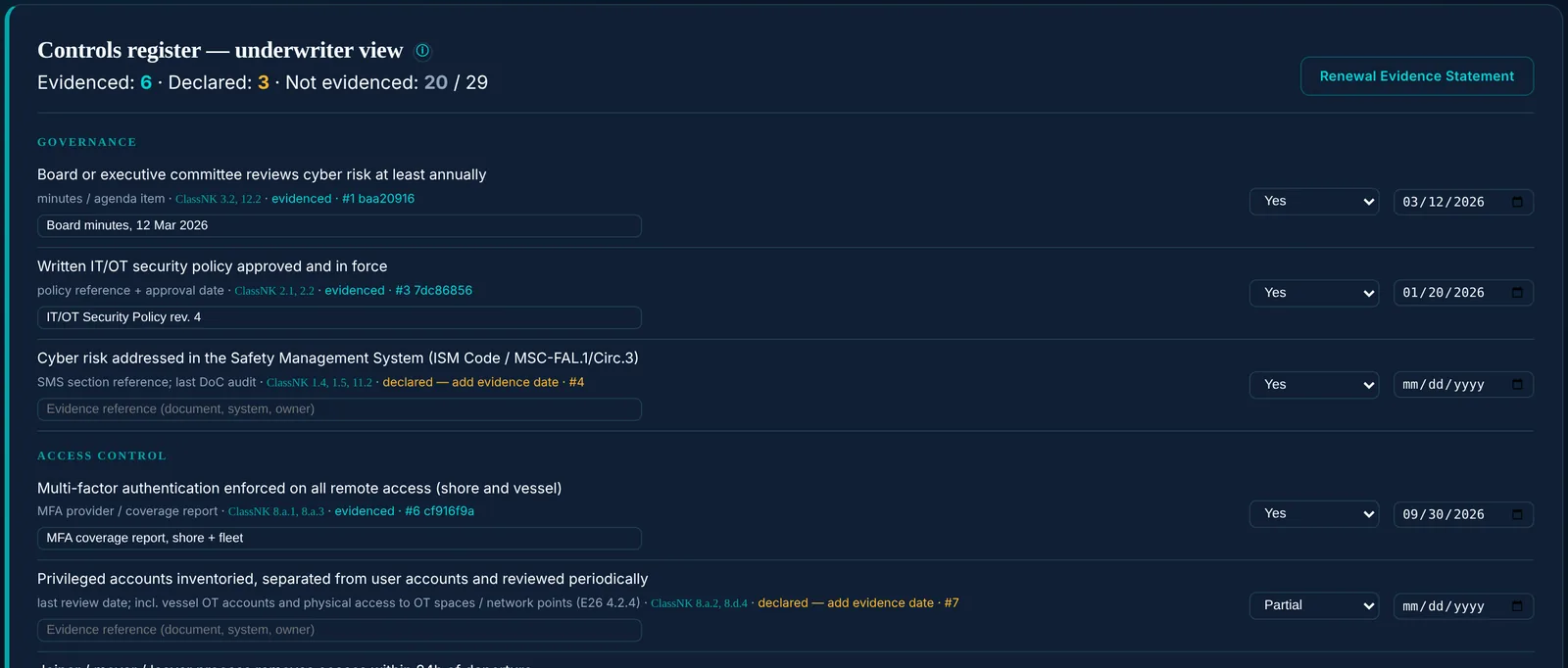
Controls registerWhich controls do underwriters and class expect?
Twenty-nine controls across office IT, vessel OT and cargo release, including the seven operation-phase controls of IACS UR E26. Each control carries its status, owner and evidence.
Renewal evidence statementWhat can we put in front of the underwriter?
Every control classed as evidenced, declared or not evidenced, exported for the insurance renewal.
DrillsDid the crew and office actually rehearse it?
Drill completion and the drill report recorded in the log.
Cargo release verificationWas the change of consignee confirmed?
Out-of-band verification of release and consignee changes. Delivery without the original bill of lading, against a letter of indemnity, is flagged.
Incidents & insurance
When something happens, the console shows who to notify and what the policy says.
Incident logWhat happened, and when did we know?
Incidents of every type, from a cyber attack to piracy, a pollution event or storm damage, recorded with their cause, the time of the event and the time it was recorded, kept separate.
Notification clocksWhose deadline runs first?
Presets for the Marshall Islands, Liberia, Panama, Bahamas, Cyprus and Malta flags, for vetting and for charterers.
Insurance programmeDoes this incident trigger the cyber exclusion?
One notification clock per policy. The incident cause sets the exclusion flag for the cyber attack clauses, and each notice is logged.
Cargo delivery recordWas cargo delivered on an unverified instruction?
Delivery events chained into the same log, with a warning when the instruction was not verified.
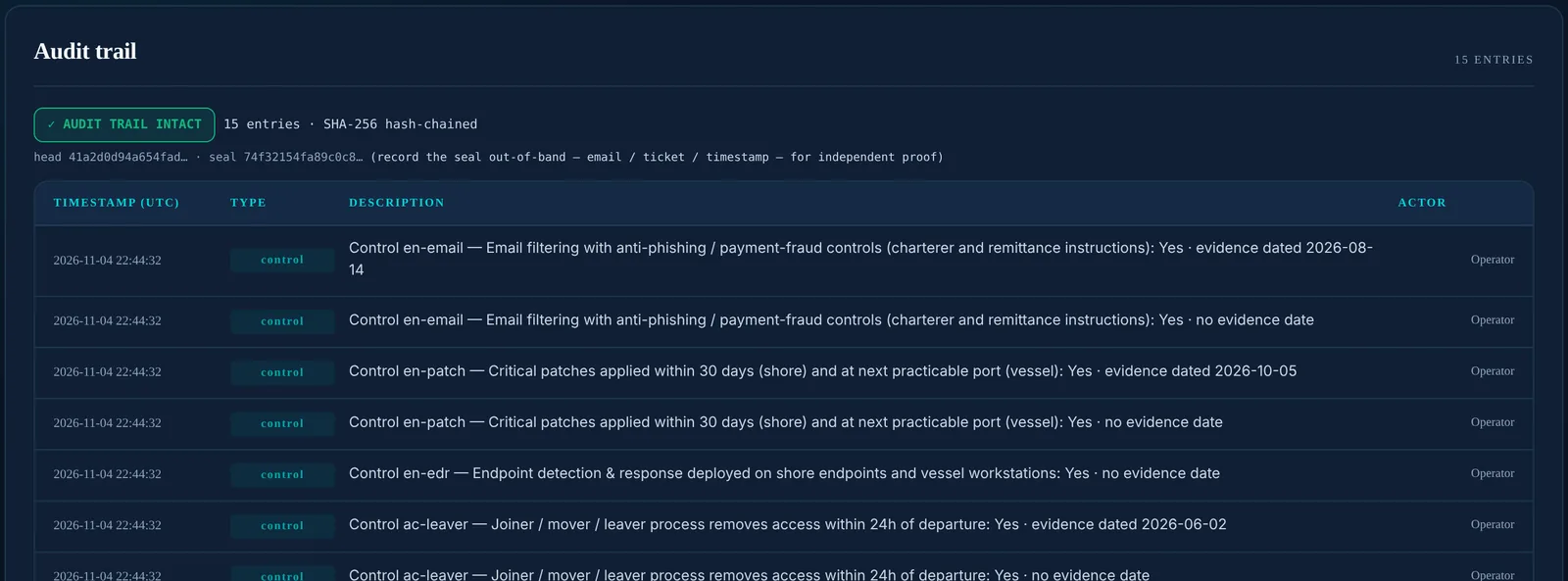
Tamper-evident log
The record that holds every other module together.
Each entry, from a control update to a policy notice, is linked to the one before it with a SHA-256 hash. Changing or removing any past entry breaks the chain, and the integrity check shows where.
What that does and does not prove: the chain shows that the log you are looking at is internally consistent and that no entry was altered without leaving a trace. It does not, by itself, stop someone with control of the whole file from rebuilding the entire history and its hashes. That is why every export and report prints the current chain head: lodge it with the auditor, class or a timestamping service, and the log can later be verified against a value nobody inside the company could change. Digital signatures and external anchoring are the step up to independent assurance; the single-file edition supports them by exposing the head, it does not perform them.
A single check that the chain is unbroken, run in the console.
A separate verifier that an auditor or underwriter can run on an exported log, without the console.
Scheme crosswalks
One set of evidence, mapped to every scheme that asks for it.
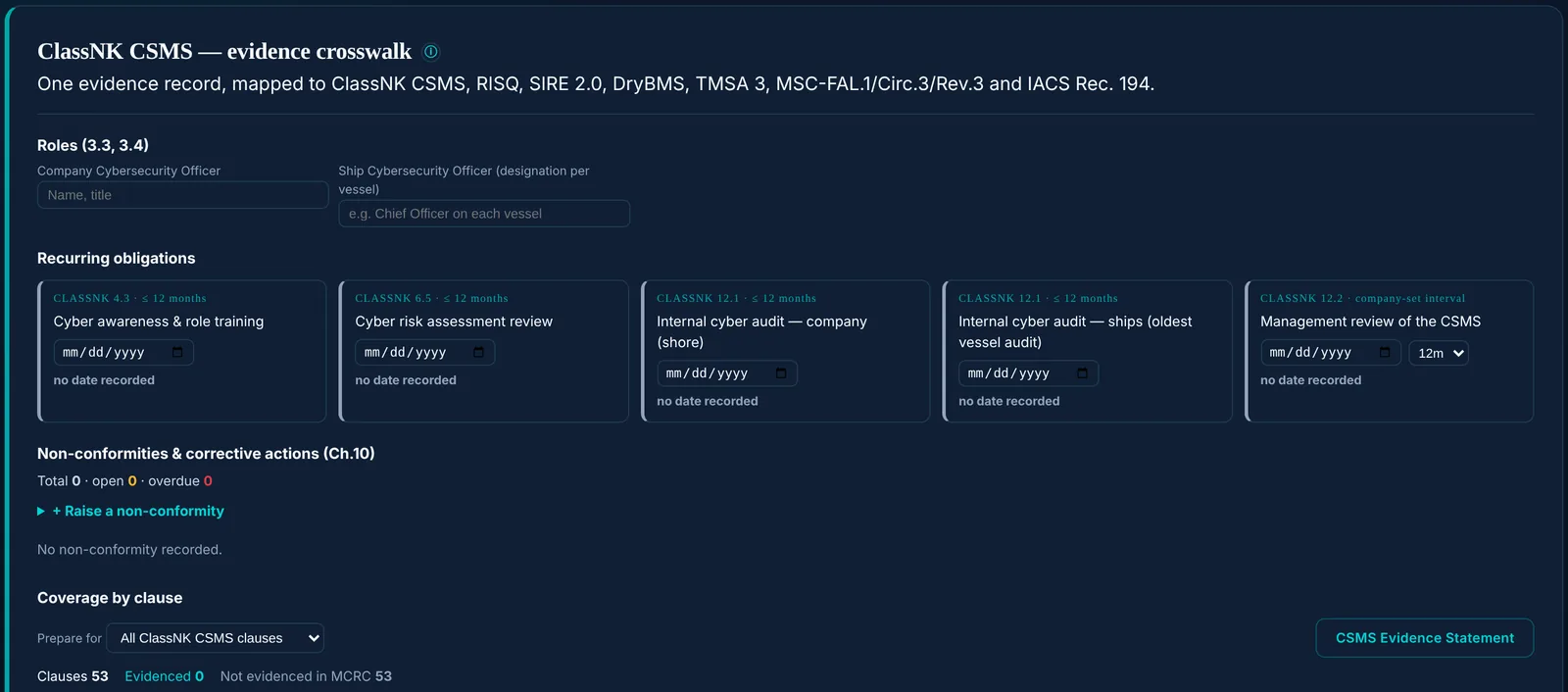
Class CSMS crosswalkWhich clauses does our evidence already cover?
Clause mapping from the ClassNK Guidelines for Cyber Security Management Systems for Ships to the other schemes, with a coverage view filtered by scheme.
Vetting & industry schemesWhat will the inspector ask?
RISQ, SIRE 2.0, DryBMS and TMSA 3 mapped to the same controls.
IMO & IACS guidanceIs cyber risk inside the safety management system?
MSC-FAL.1/Circ.3/Rev.3, IACS Recommendation 194 and the IACS cyber resilience requirements UR E26 and E27.
Renewal clocks & corrective actionsWhat expires, and what is still open?
Twelve-month review clocks and a register of non-conformities and corrective action plans.
What MCRC is, and what it is not
It is
A governance and evidence console. It records controls, incidents, notices and drills, and shows which obligations they meet.
It is not
A monitoring or intrusion-detection system, and not a claims register. The log is tamper-evident, not tamper-proof: it shows that a record was changed, and it cannot on its own prove who changed it or rule out a rebuilt history. Non-repudiation needs the chain head anchored outside the company and entries signed — a multi-user production deployment, not the single-file edition.
What carbon does to each loan's cash flow and collateral — on your own book, before the next review
MCCS-BV reads a shipping loan book the way credit reads it. For every financed vessel it prices EU ETS, FuelEU Maritime and the proposed IMO Net-Zero Framework, then carries the cost through disclosed rules to the borrower's debt service, the vessel's value as security, the loan-to-value and an LGD input — base and stressed, with the assumptions on the page. It is an input to the bank's own rating, collateral and RWA processes, not a valuation and not a PD.
Runs offline on your own computer · portfolio data stays on the bank's machines
2025 emissions are surrendered at 70% by 30 September 2026; 2026 emissions at 100%, surrendered in 2027. From then on it is a recurring cash cost on every EU voyage.
Intensity targets step down in 2030, 2035 and 2040. A ship's annual deficit, after banking, borrowing and pooling, is penalised at €2,400 per tonne of VLSFO-equivalent energy.
Climate factors are entering collateral valuation, and Poseidon Principles signatories report portfolio alignment every year.
One loan book, one carbon price
Eighteen financed vessels, €1.0bn of collateral, €550M of loans. At today's allowance price the carbon bill is €24.0M a year; carried through the LGD lens in six checkable steps it takes 16% off the collateral, moves the loan-to-value from 55% to 66% and the LGD from 30% to 46% — and at €200 the cover is close to gone. Half pass-through to charterers halves the effect. The two-page case, with the rule and every input stated, is on the Insights page.
Lender view
The portfolio as credit and risk teams read it.
Portfolio statusWhere does the book stand today?
Exposure across borrowers and segments, with the red flags that need follow-up first.
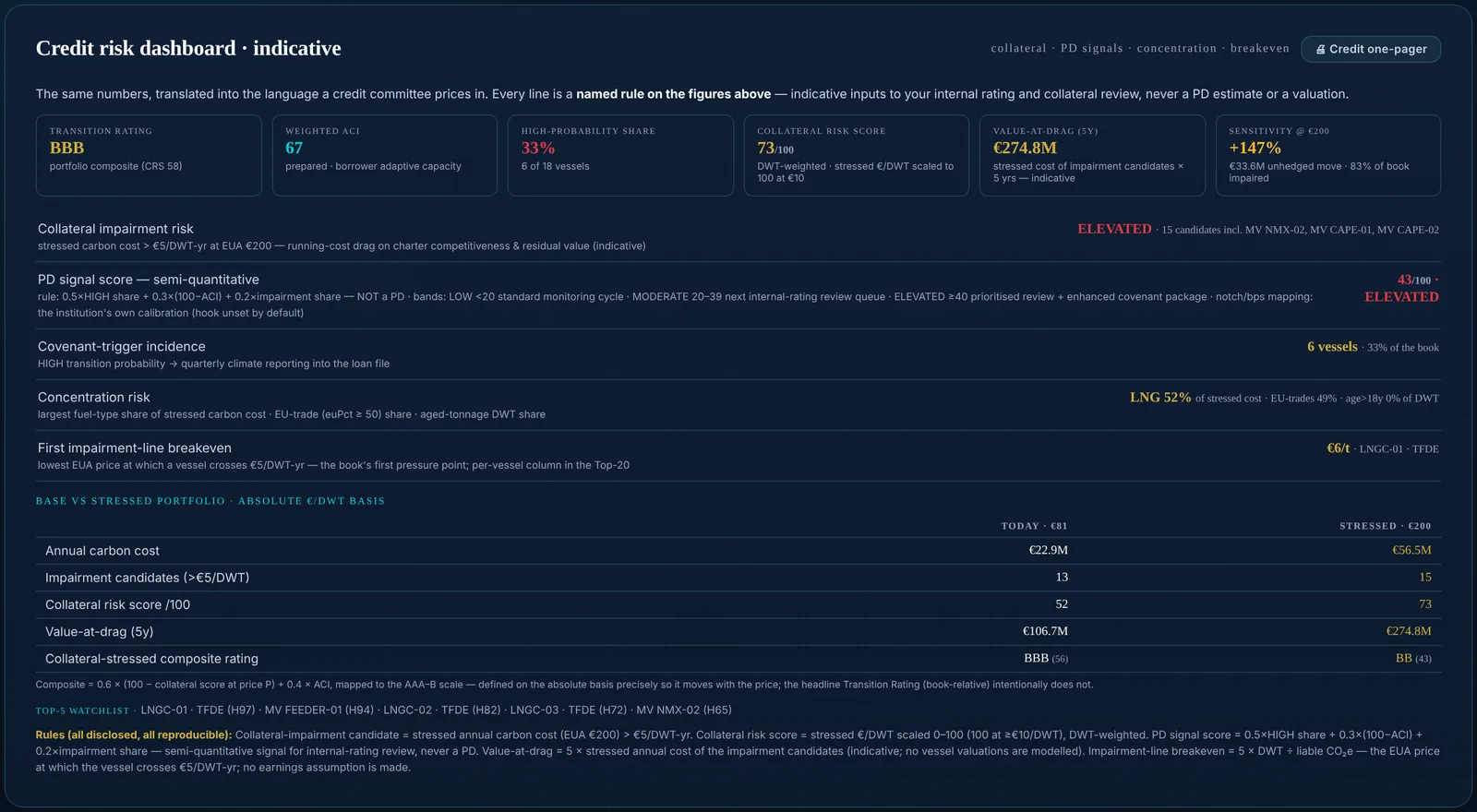
Credit risk dashboardHow far does the stressed case move?
Regulated cost per borrower and per loan, base against stressed, with named scenarios saved for committee.
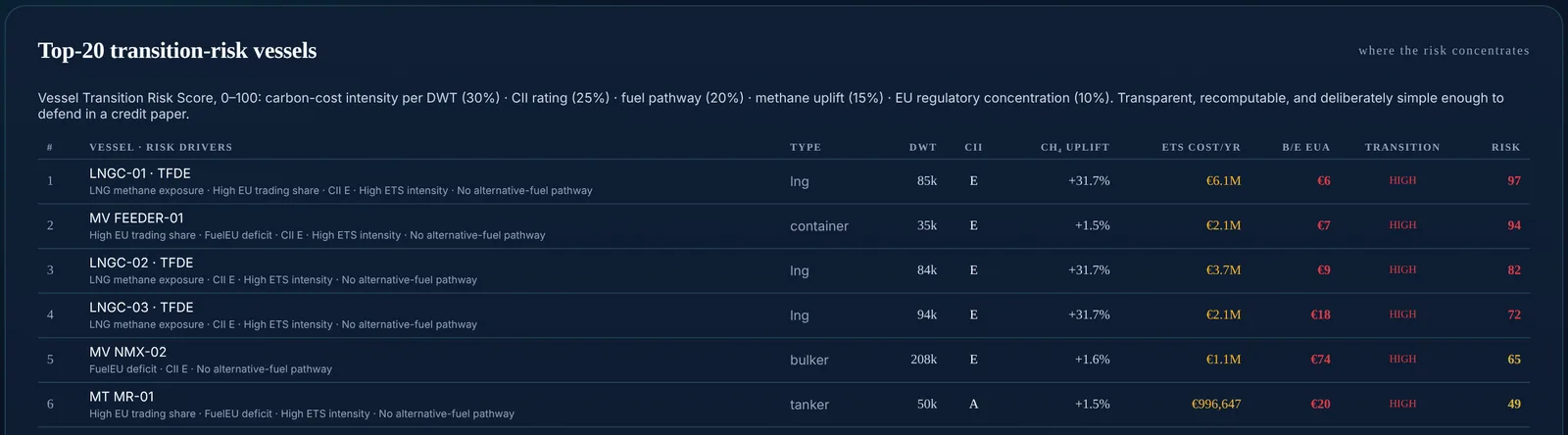
Top-20 transition-risk vesselsWhich ships carry the most risk?
The financed vessels ranked by transition risk, with a watchlist of stranded-asset candidates.
LGD lensHow does carbon reach loss given default?
The path from carbon liability to collateral value and loan-to-value over the life of the loan.
Climate-adjusted collateralWhat is the vessel worth with carbon priced in?
Vessel value reduced by the carbon liability it carries.
Decision supportWhat should the desk do tomorrow morning?
A short list of actions drawn from the red flags and the watchlist.
Stress & scenarios
Tests that credit committee can repeat.
Adaptation stress testWhat if the EUA price, target year or fuel mix changes?
One-click shocks on the main assumptions, applied to the whole book.
Policy sensitivity gridWhich assumption matters most?
Results across a grid of carbon price and policy settings.
Adaptive capacity indexCan the borrower absorb the cost?
A reading of each borrower's room to adapt the fleet.
IMO Net-Zero FrameworkWhat if the global charge is adopted?
Applied as an optional stress, separate from the base case.
Fleet & regulation
The rules applied to each financed vessel.
Fleet inventoryHow does the book get in?
Vessels added one by one or by bulk import, with a guided estimation wizard where borrower data is missing.
Emissions & GHG chainHow does fuel become a liability?
The chain from fuel burned to CO₂e and to regulated cost, with Scope 2 and 3 shown separately.
EU ETS exposureWhat does each vessel surrender?
Per-vessel ETS exposure on a CO₂e basis, with UK ETS maritime in the regime coverage.
FuelEU & flexibilityWhat can a borrower's own pool offset?
Penalty trajectory under the current fleet mix, the gross penalty against the pool, the flexibility mechanisms and the RFNBO reward.
CII screenWhich ships drift to D or E, and when?
Ratings today and along the tightening reduction path, vessel by vessel.
Poseidon Principles alignmentIs the portfolio on the trajectory?
Per-vessel intensity against the official trajectories, rolled up to portfolio level and weighted by debt outstanding.
Model governance
So credit and risk can defend the number.
Governance recordWhich assumptions produced this result?
Every assumption, factor and scenario stated and exportable.
Corrective-action checkDoes the borrower have a plan?
Whether a corrective action exists for each vessel that falls short.
| Step | What happens |
|---|---|
| 1 · Load | The shipping book: vessels, fuel, EU exposure, loan and market value. |
| 2 · Apply | ETS on a CO₂e basis, FuelEU well-to-wake, IMO NZF as an optional stress. |
| 3 · Stress | EUA price, target year and fuel mix, with the result exported for credit committee. |
A pilot on the bank's own portfolio
Pilot, then transfer
A supervised pilot on the bank's own portfolio, then a methodology transfer the bank owns, with no ongoing dependency.
Data stays with the bank
The tool runs locally in the browser, so portfolio data stays on the bank's machines. It complements existing risk systems as a quantification layer and replaces none of them.
DORA advisory on ICT risk and third-party providers can run in parallel, for banks that need both.
Scope first, distance second
For every desk that prices a voyage: brokers, charterers, owners, operators, banks and analysts. Sailing distances are published elsewhere. What a desk cannot look up is how much of a voyage falls under EU ETS and FuelEU Maritime. The Reference states that share for every tabulated port pair, together with the distance and the carbon per mile for common vessel types.
What the edition contains
One annual edition, tied to the FuelEU target year; interim releases within the year carry a point version. Current release: v1.16, 7 Nov 2026 — the same table the MCCS v4.24.6 builds carry.
237 ports across 19 regions, each with its country, EU/EEA status and the trades it serves.
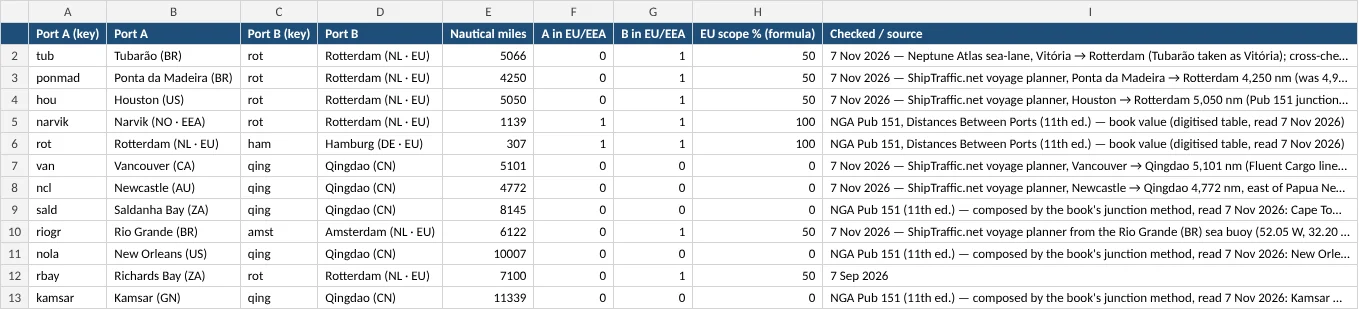
479 port pairs. 158 of them (33%) are checked: read against a named external source on a stated date — 95 NGA Pub 151 book values, 63 against voyage planners, sea-lane calculators or Pub 151 junction compositions. The other 321 are curated: RCA working figures from standard tables and junction compositions, labelled as such, to be verified before they are quoted in a fixture. Every row says which it is; the checked share rises with each release.
The main tanker, dry bulk, container and gas lanes with their scope class.
Ready voyages with distance, scope and carbon, recomputed from stated assumptions.
Emissions per nautical mile for thirteen vessel archetypes.
The legal basis for each scope rule, the transhipment exception and the derogations that do not apply.
Distances are cross-checked against published distance tables. UK ports are shown separately and are not counted in EU scope.
Workbook
The core deliverable: the master table, regional sheets, templates driven by an assumptions sheet, and the scope guide. Data files are included for import into the desk's own systems.
Presentation kit
A printed executive summary in a presentation folder, a desk wall sheet and an access card for the digital edition. Licensed per desk.
Analysis on maritime carbon and resilience regulation
Published commentary on how carbon and resilience rules reach charter contracts, fleet decisions and financing.
The morning after: what December's IMO vote means for a fixture
A Kamsarmax fixture reported in the market, priced twice: under the EU rules already in force, and with the global charge the IMO vote could add. The piece shows what changes in the voyage numbers the day after adoption, and who in the charter chain would carry it.
Read on Splash247 → https://splash247.com/the-morning-after-what-decembers-imo-vote-means-for-a-fixture/Who owns shipping's carbon decisions?
Carbon cost on a single voyage now grows year by year as FuelEU targets tighten. The article argues that the risk lies less in the tools companies use than in who inside the company holds the authority to decide on that cost.
Read on Splash247 → https://splash247.com/who-owns-shippings-carbon-decisions/New articles are added here as they are published.
Worked examples: a fixture, a fleet, a loan book
Short documents built on the tools, the way a desk would use them: inputs, assumptions, result and the decision it informs. Vessel archetypes, not named ships; no client data. Each opens here on the page, with a button to save the PDF.
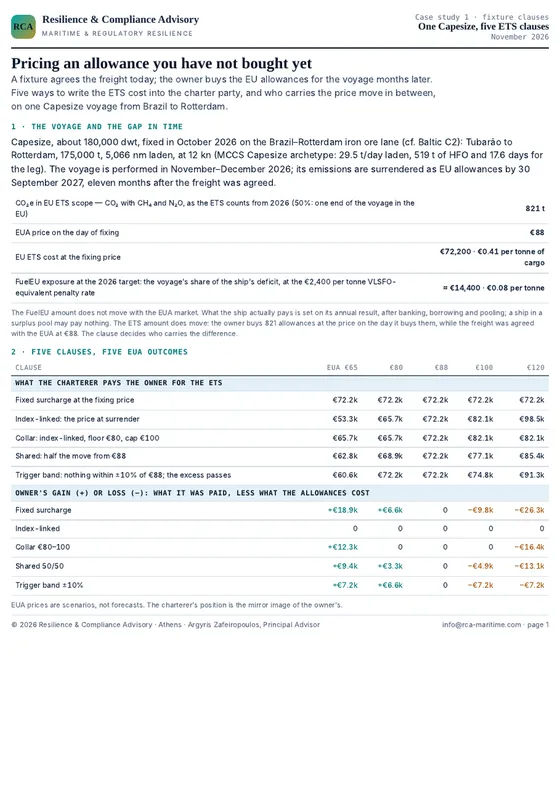
One Capesize, five ETS clauses
Tubarão to Rotterdam, 175,000 t of iron ore, 821 allowances due eleven months after the freight was agreed. Fixed surcharge, index-linked, collar, shared adjustment and trigger band, each priced at five EUA levels with the owner's gain or loss, and the three things the clause has to name.
Read · 2 pages →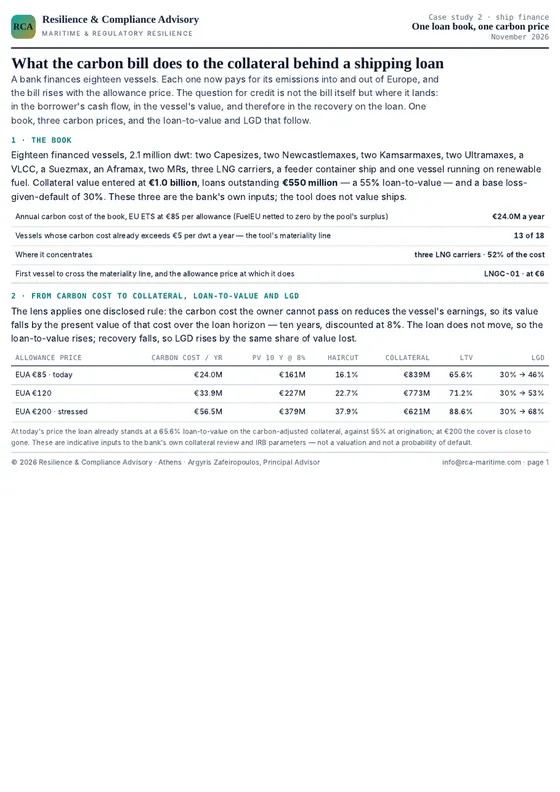
One loan book, one carbon price
Eighteen financed vessels, €1.0bn of collateral, €550M of loans. The carbon bill at €85, €120 and €200 per allowance, carried step by step — annual cost, cash-flow impact, capitalised liability, haircut, LTV, LGD input — with every assumption on the page, so a credit analyst can repeat it on a calculator.
Read · 3 pages →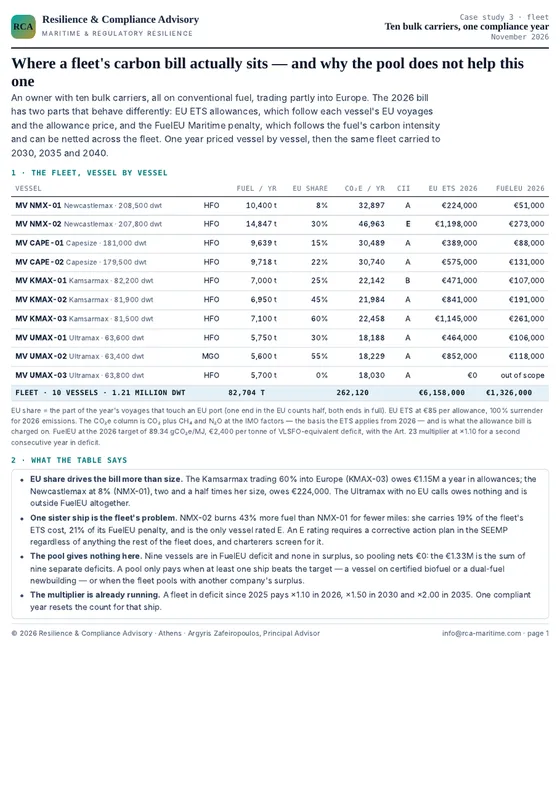
Ten bulk carriers, one compliance year
An owner's fleet priced vessel by vessel: why EU share matters more than size, why one sister ship carries a fifth of the bill, why the pool saves nothing without a surplus ship, and what the same fleet owes in 2030, 2035 and 2040 as the targets and the multiplier tighten.
Read · 2 pages →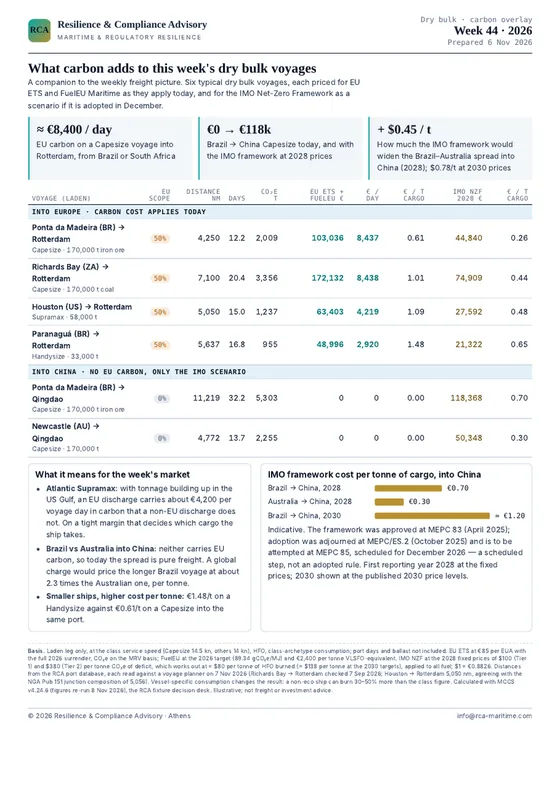
What carbon adds to this week's dry bulk voyages
Six typical voyages into Europe and into China, each with EU ETS and FuelEU as they apply today and the IMO Net-Zero Framework as a 2028 scenario: € per voyage, per day and per tonne of cargo, and what it means for the Atlantic Supramax and the Brazil–Australia spread.
Read · 1 page →Figures from MCCS Broker and Owner v4.24.6 and MCCS-BV v1.39, run 8 Nov 2026. Illustrative: archetype vessels and stated inputs; not advice — see the legal notice. An end-to-end, anonymised voyage case, from recap to clause, follows in a later edition.
Resilience & Compliance Advisory
RCA is an Athens-based practice that studies maritime carbon, resilience and cyber regulation and turns the findings into methods and tools that clients keep and run themselves. Its work covers EU ETS, FuelEU Maritime and the IMO framework on the carbon side, and NIS2, CER and DORA on the resilience side.
The cost is decided at the fixture; the bill arrives a year later, on someone else's desk
EU ETS and FuelEU Maritime are priced, in practice, after the fact: the allowances are bought and the penalty is settled months after the freight was agreed, by a department that was not in the negotiation. The chartering desk, the broker and the lender each see a piece. The tools that exist are either annual reporting systems or subscription platforms that keep the data and the method on their own servers.
It puts the regulation's arithmetic where the decision is made — on the desk, before the fixture, in a file that runs on the company's own computer — with every figure traced to the rule and the input that produce it, and the method handed over so the client is not dependent on us. The same engine serves the charterer, the owner and the bank, so the three read one number.
Not a verifier, not a registry, not a trading or hedging service, and not a source of freight or investment advice. The tools quantify; the judgement, the negotiation and the decision stay with the client.
Argyris Zafeiropoulos
Principal Advisor, Resilience & Compliance Advisory
Argyris Zafeiropoulos works as a scientific analyst in shipping and publishes on how carbon pricing and resilience rules reach the commercial and financial decisions of shipping companies: the allocation of carbon cost in charter contracts, the effect of FuelEU Maritime on fleet strategy and vessel values, and the cyber-governance evidence a listed group has to hold. The tools on this site are that research made operational — the same arithmetic, on the client's own desk.
What he brings to each of them comes from more than three decades in technology, banking and regulated organisations, and the three products follow that career closely.
He served as Executive Vice Chairman and later General Manager of a Greek bank and chaired its investment arm. MCCS-BV is written from the credit committee's side of the table: it says what a CRO can use (collateral haircut, LTV, an LGD input, Poseidon alignment) and what it refuses to be (a valuation, a probability of default, a rating).
A mathematician and computer scientist by training, with fourteen years in senior roles at two Fortune 500 technology multinationals — a decade at a global IT group, four years at a semiconductor leader — and several technology ventures of his own. That is why the tools are built from scratch rather than assembled from a platform, run on a single file with no server, and carry every figure back to the rule and the input that produce it.
He has chaired a public-sector pension fund and run a bank under supervision, and advises banks on DORA, NIS2 and CER. He knows how an examiner reads evidence — which is what the MCRC tamper-evident log and the Study's NIS2 / CER / SEC-SOX crosswalk are built for.
He studied Mathematics and Computer Science at the University of Athens and holds an MBA from the University of Sunderland, with postgraduate programmes in Computer Science, Business Administration and Real Estate. He has led Resilience & Compliance Advisory since 2025.
What the figures rest on
| Figure | Source text | How it is applied | Checked to |
|---|---|---|---|
| EU ETS maritime | Directive 2003/87/EC as amended by 2023/959; MRV Reg. (EU) 2015/757 | Phase-in by emissions year: 40% of 2024, 70% of 2025 (surrendered by 30 Sep 2026), 100% of 2026 emissions (surrendered in 2027); 50% of voyages with one EU end, 100% between EU ports, berth in full; CO₂e (CH₄, N₂O) from 2026 emissions; EEA ports included | 8 Nov 2026 |
| FuelEU Maritime | Reg. (EU) 2023/1805, Annexes II & IV | Baseline 91.16 gCO₂e/MJ; −2% from 2025, −6% 2030, −14.5% 2035, −31% 2040, −62% 2045, −80% 2050; €2,400 per tonne VLSFO-equivalent deficit; pooling, banking, borrowing; Art. 23 consecutive-deficit multiplier; Norwegian and Icelandic ports third-country ports until the regulation is incorporated into the EEA Agreement — no earlier than 1 Jan 2028 per the Norwegian Maritime Authority (11 Aug 2026) | 8 Nov 2026 |
| CII | IMO MEPC.352–355(78), MEPC.338(76) | Per-vessel AER against the required line, ship-type dd vectors, annual reduction factors | 8 Nov 2026 |
| Emission factors | IMO MEPC.364(79); FuelEU Annex II | Tank-to-wake CO₂, CH₄ and N₂O per fuel, combined as CO₂e (GWP₁₀₀); well-to-wake intensities per pathway | 8 Nov 2026 |
| IMO Net-Zero Framework | MEPC 83 approved text (April 2025); adoption adjourned at MEPC/ES.2 (October 2025); adoption to be attempted at MEPC 85, scheduled for December 2026 — a scheduled step, not an adopted rule | Scenario only, labelled as such: Tier 1 / Tier 2 remedial units at the 2028–2030 prices, Z-factors to one decimal; never added to an EU figure without saying so; dropped or re-dated the day the IMO decides otherwise | 8 Nov 2026 |
| Distances | NGA Pub 151 (public domain); junction compositions; voyage planners and sea-lane calculators for pairs Pub 151 does not tabulate | RCA Port Distance Reference v1.16 (7 Nov 2026): 237 ports, 479 legs, of which 158 (33%) checked against a named source on a stated date and 321 curated working figures labelled as such; the tools show the label on every leg | 7 Nov 2026 |
| Vessel archetypes | RCA reference archetypes, reviewed July 2026 | Class speed and consumption used only where the client has not entered the vessel's own figures; ±15–25% against a named ship, and the tools say so | Jul 2026 |
No index-provider route or benchmark data is used in the tools; index route codes appear only as orientation. When a rule changes, the date in this table and in each build moves with it, and clients receive an updated build with the change named in its changelog.
Every number is tied to the regulation and the data that produce it.
Methods are transferred to the client, with no ongoing dependency.
Tools run on the client's own machines.
A quantification layer beside existing systems, replacing none of them.
Request a demo
Bring a fixture. Bring a fleet. Bring a credit portfolio. The demo runs on it, on the tool you are interested in, and takes about 45 minutes — online or in Athens.
What a demo shows
Your fixture priced end to end: regulated cost, break-even freight, the allocation clause, and what moves when the EUA, the bunker or the distance moves.
Your fleet list on the desk: which vessels carry the liability, the FuelEU trajectory to 2030, pooling, and the disclosure statements built from the same figures.
A slice of the loan book: carbon cost against each vessel's cash flow and collateral, base and stressed, and the Poseidon view of the portfolio.
Your controls register and an incident walked through the console: notification clocks, evidence, and the tamper-evident log an auditor reads.